It has been generally accepted that sweathouses were resorted to as a prophylactic sauna-treatment for aches and pains.
But far more aches and pains would have been incurred in heating a sweathouse than would ever have been alleviated. For a start, the entrance is as little as 75 cms high. To light a turf fire, maintain it and sweep out the ashes, ans strew the floor with bracken or rushes was no easy task. Even if the roof were partly dismantled to put the turf in, this would have been almost as awkward as bringing or throwing it in through the entrance - and the hot ashes would still have had to be swept out.
In a society where everyone had rheumatic pains and arthritis at the very least, and where it was regarded as the normal human condition, it is it really likely that sweathouses several hundred metres from the nearest (stone) house, holding a maximum of 5 people in considerable discomfort and some risk of fainting or even burning, would have been used for the uncertain alleviation of aches and pains ?

Tirkane, county Derry, with shallow well in foreground
The better-off rubbed themselves with
poitín
and patent rubs on sale at markets and fairs; the poorer drank what they could get -
poitín
, or, in mid-Ulster, ether - to ameliorate bodily discomfort. In any case, sauna treatment is of no avail to such complaints as sciatica, arthritis, and the aching backs still suffered by a high proportion of the more mature population. Arthritic hands and feet would be relieved more easily and effectively by immersion in warm peat-ash from an overnight fire than by squatting uncomfortably in a tiny, dark place.

Sweathouse doorway seen through a hole in the corbelled roof,
Cuiltia, county Leitrim
So - unless they were a local phenomenon like mid-Ulster ether-drinking - why were sweathouses (never more than 1.75 metres high internally and two metres in internal diameter) built in such numbers ? (It is safe to assume that those which survive represent a tenth or less of the total built just in the county Leitrim.) What could they have been used for ? And when were they introduced ?
Mrs McLoughlin of Tullynafreave claimed in 1992 that her maternal great-grandfather built the sweathouse standing some 50 metres from her modern dwelling to save his wife the trouble of travelling to the sweathouse in neighbouring Meenaslieve.
She said that her grandmother and perhaps her mother also had used it, and did not think that their spouses had done so. But whether this is an isolated example of late construction (say around 1885) is impossible to determine. Similarly, it is impossible to establish a connection with the coal-mines (in use from the late eighteenth to the late twentieth centuries) that are at the heart of the currently-known distribution of sweathouses - now reported also from south-west Scotland.
Sweathouses are, of course, part of a circumpolar phenomenon which produced the now well-known Finnish
sauna
.
The Turkic tribes who moved from central Siberia and eventually overthrew the Byzantine Empire, seem to have easily adapted to the Byzantine and Roman steam-bath, producing the
hammam
or Turkish Bath. The North American form was the
sweat lodge
, used not for mere hygienic reasons, but as part of the initiation procedures for boys' passage into manhood. We can be sure that the Finnish sauna was not used for hygienic resons before the 19th century obsession with cleanliness as the prime virtue took hold in the Protestant countries of the North.

Gubnaveagh, county Leitrim
The first Turkish Bath to be established in the British Isles was in county Cork in the 1860s - so there is no likelihood that it inspired simple Irish sweathouses, concentrated much farther north.
The Finnish sauna was an offshoot from a Siberian-Mongolian practice, so it is reasonable to suppose that the Irish sweathouse came from Scandinavia via the Vikings or their successors in the Northern Isles at some time between the 10th and the 15th centuries.
Before their secularisation, saunas were part of the universal combination of religious, medicinal and psycho-therapeutic modes which have only recently, like much else, been split off and compartmentalised by Western science and pseudo-science. Our culture has, as a consequence, taken 'exotic' and exciting elements of other cultures' psycho-social therapies (coffee, cocoa, tobacco, cocaine, cannabis and so on) as mere stimulants and 'highs'. The Turks made the public
hammam
a part of quasi-religious male confraternity. The Finns have likewise made the communal sauna a kind of men's club. Sweating is one of the many ways of altering consciousness, particularly when it is part (as in North America) of a series of tests and ordeals - and especially when it is done in the dark.
The medicinal psycho-therapy of Siberia and Mongolia, which is still practised by shamans both male and female, involves mushrooms (Fly Agaric), alcohol, sweating and rapid cooling, fasting, whirling, sleep-deprivation and so on. These produce visions and out-of-body experiences, and are aids to achieving more aware states of consciousness than 'Western values' approve of, whereby the shaman-practitioner can see causes of illness or malaise, and the non-shaman can be suitably awed by the psychic forces released by the unblocking effects of physical ordeal and psychoactive drugs.
Herodotus describes the Scythian practice of altering consciousness through cannabis by throwing the seeds on hot stones inside a tent and inhaling the vapour - the smoking of cannabis and opium is a rather late development. Long before the Scythian incursions, however, cannabis seems to have been inhaled at La Hougue-Bie on the island of Jersey, where 21 pottery vessels marked with burnt resin were found in the untouched chamber recently discovered. Consciousness-improving substances have, of course, been found also in other European sites: the Iron Age site of Wilmersdorf, for example, where remains of cannabis were found in an urn.

Sweathouse with unusually large and grand entrance
recalling a passage-tomb, Annagh Upper, county Leitrim
Closer to Ireland there have been serious suggestions that the "burnt mounds" also known as "ancient cooking-places" or
fulachta fíadh,
found in huge numbers in Ireland - and also in Britain - might have been used as sweat-lodges in the North American style, or as places for warm-water bathing. These shallow ponds, heated by rolling hot stones into them, could have had many purposes, of course - and warm baths would have been an obvious secondary function.
Could Irish sweathouses be a continuation of a tradition as old as the
fulachta fíadh
? They are very flimsy structures, easily subject to total demolition by livestock, and would survive from prehistoric times only through the most extraordinary circumstances - so no evidence is likely to emerge.
Could they be survivals of consciousness-improving chambers as at La Hougue-Bie and Wilmersdorf, latterly overlaid with the prophylactic function of saunas ?
Cannabis is not likely to have been used in Ireland for a millennium at least, but a much more seriously-numinous means of widening the awareness is still to be found all over the island.
There is a great deal of literature on the effect and use of various kinds of mushroom (
Psilocybe
spp. and Fly Agaric). The appearance of the formerly ubiquitous "magic mushroom",
Psilocybe lanceolata
, fits rather well with descriptions of pixies, leprechauns and other 'little green men'. A more gross mushroom-spirit is the modern Santa Claus, dressed in the colours of Fly Agaric, associated with reindeer (from whose urine the unmetabolised but detoxified active constituent was drunk bv the shamans of sub-arctic reindeer-herdsmen, who enters down a chimney and brings gifts. The entrance to many circumpolar dwellings is also the smoke-hole, as in Irish sweathouses. In our culture of acquisition the gifts are meaningless objects of desire rather than real numinous Gifts, and the shaman figure (who degenerated to Father Frost in Westernised Russia and Scandinavia) coalesced with St Nicholas, the Three Magi and the ancient gift-tradition of Saturnalia.

Corradeverrid, county Cavan
If Irish sweathouses were used like the secularised
hammam
and sauna, why were they not built close to stone-built dwellings and their turf-stacks ? Why were they, as reported, used infrequently - mostly in the Autumn ? Were they used exclusively by one sex ? Does one report of an "itinerant bath-master" indicate a psycho-therapeutic use supervised by a travelling doctor-shaman or Wise Man ? And why, in a country which, until the use of chemical fertlisers, was in October and November (the time of
The Gap of the Year, Samhain,
Hallowe'en) carpeted with
Psilocybe lanceolata
, also known as Liberty Caps, is there no record of their use ? These mushrooms are still plentiful on marginal land and on the edges of chemically 'fertilised' agricultural land. But there is a pattern of "collective forgetting" of mind-
expanding
plants and their extracts by cultures which inevitably adopt mind-
numbing
drugs such as alcohol. Thus the identity of Soma was lost, and only inactive "substitutes" were identified.
It seems unlikely (though not impossible) that
Psilocybe
mushrooms were not consumed up to the time of the Famine - but of course the agonising and protracted trauma of the hungry years and the halving of the population by death and emigration affected Irish behaviour and attitudes to Wild Food or "famine food" - as nutritious nettles, rose-hips, elderberries and so on are still considered. After the Famine, only grocery-store victuals were eaten. Even now, eating blackberries is far from universal in Ireland: those who pick them tend to be English, other foreigners, or local children paid (a penny a pound, as I remember in the 1960s) to gather them.

Tullynahaia, county Leitrim
For the decline of Irish traditions right across the spectrum, the Famine was Pelion piled upon the Ossa of Catholic Emancipation of 1829. This resulted in the rapid application to Ireland of a very urban-English Victorian-puritan 'respectability' that ran counter to many of the old ways and practices which had survived until the Penal days - practices which were bowdlerised and Christianised when they could not be suppressed. Ireland became for the first time - and remained until the end of the 20th century - a highly-conservative society which had also lost its traditions, and whose mores came from the right wing of the Catholic church. This is in contrast to Italy, for example, where all sorts of "pagan" survivals (from frog-cults and wolf-veneration to bleeding statues) can still be found in the centre and south, while sceptical atheism is almost the norm in Tuscany and the north.

Annagh Upper (side view), county Leitrim.
So, after the Famine, few would have claimed or admitted to remember the eating of
Psilocybe
, which, it should be noted, were free, abundant and (through drying) available all year, and produce a state of consciousness far above that induced by alcohol. The world-wide phenomenon of the replacement of natural and fairly benign plants by manufactured, expensive and toxic alcohol is a sad paradigm for the take-over of the world by toxic "turbo-capitalism".
In the same way, 'pagan' practices such as painting or capping phallic stones, using cure-stones (which were promptly and cleverly dubbed
curse-stones
) some of which still survive, wild dancing (for which the Irish were famous) and the veneration of Fairy Thorns were discouraged.
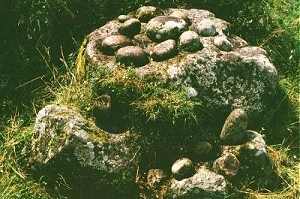
Cure-stones, Killinagh, county Cavan
If dark, chthonic sweathouses had a psycho-therapeutic function stretching back at least to Bronze Age times, we can be sure that they too would have been discouraged by the twin powers of Church and State. By the time that uncasual enquiries started (after the First World War) they had fallen into desuetude, and their use had been erased (like much else) from the collective memory.
Small wonder that enquirers were fobbed off with glib explanations of autumnal prophylaxy and 'sweating out the bad' as Mrs McLoughlin expressed it. It is likely that by the dawn of the 20th century very few people knew how they had been used, for in Ireland the rupture of handed-down knowledge, especially from mothers to daughters, occurred earlier than anywhere else in rural Europe. To find out the used and properties of wild plants we have to go to English sources which are still relatively rich - for in England there has been no Great Forgetting beyond that of the universal secret history of the ignored, eschewed, female and oppressed.

Assaroe, county Donegal
How much arcane knowledge died in the hedges with Famine victims, or was carried across the ocean to America and deliberately forgotten there, we will never know. What we can be sure of is that there has been in Ireland a Great Disremembering which acted as undertaker to the Great Hunger, and may still not have run its course. And although sweathouses still lurk in secret places and leprechaun-hatted
Psilocybes
still grow, their use and possible connection remain as obscure to us as the mind-set of Mesolithic hunter-gathers, the cosmology of Celtic kinglets, or the ecstasy of Atlantic anchorites.
click on the thumbnail
 for a larger picture
back to
 part one
[This text has been expanded from articles which previously appeared in
Archæology Ireland
(volume 3 number 1, 1989) and
The Ley Hunter
(number 119, September 1993)
.
]

This page is included on the
 inspired by this website
.
inspired by this website
.

|
I am indebted to Bob Trubshaw,
http://www.indigogroup.co.uk
for his generous moral and material help
in the creation of this web-page,
which is dedicated to the memory of
E. Estyn Evans.
|