Dissident Editions
home =   free book =  Guestbook  =  feedback =   about us 

logo


POETRY

poems of the month

the diogenes sequence

i am and am not:
      fragments of rumi

destiny and destination

the zen of no-enlightenment

already backwards

a light in ruins

the iraqi monologues

separate amputations

the sexy jihad

awaiting the barbarians

the smell of possibilities

ultimate leaves

rejoice in the dog

post-millennium maggot

the book of nothing

dispatches from the war against the world

albanian poems

french poems in honour of jean genet

the hells going on

suicide for
non-beginners

fearful symmetry

book disease

foreground trouble

the transcendental hotel

cinema of the blind

lament of the earth mother

uranian poems

haikai by okami

haikai on the edge

black hole of your heart

jung's motel

leda and the swan

confession from belgrade

gloss on rilke's ninth duino elegy

jewels and shit: poems by rimbaud

villon's dialogue with his heart

vasko popa: a shepherd of
wolves ?

the rubáiyát of omar khayyám

genrikh sapgir:
an ironic mystic

the love of pierre de ronsard

imagepoem


TRANSLATIONS


BETWEEN POETRY AND PROSE

400
revolutionary maxims

nice men and
suicide of an alien

vacuum of desire:
a 'gay' correspondence

anti-fairy tales

the most terrible event in history

the rich man and the leper


ESSAYS

running on emptiness

a holocaust near you

a note on the cathars

happiness

londons of the mind
& dealing death to the caspian

genocide

a muezzin from the tower of darkness

being or television

satan in the groin

womb of half-fogged mirrors

tourism and terrorism

the dog of sinope

shoplifting
in britain & america

this sorry scheme of things

the bektashi dervishes

a holy dog
& a dog-headed saint

fools for nothingness

death of a bestseller


Nuadú, God of War


field guide to megalithic ireland

houses for the dead

french megaliths


a small town in france


unsolicited
feedback from a visitor to this site:-


"Many poets work hard, really hard, to create works that they feel will be beneficial to our society, yet for the most part they are shuffled off into "high art" obscurity or simply ignored.

I think these good people should be encouraged, supported if possible, and their work disseminated."

- William Pusztai Toronto


LINKS

REVIEWS


Double self-portrait by Anthony Weir


of: this web site

"This is one of the most fun and interesting sites I've ever visited. Great art, wonderful poems from the abstract to the highbrow. I only wish the French poetry page had a translation. There is also archeology...could spend the whole day here.
...Easy to negotiate, clear and uncluttered website, full of wonderful pages and links. The Doggy pages are wonderful.
This should be six stars, but will have to give it
[our maximum] ."

Shane Land Poetry Search Engine


« Here is great poetry, which penetrates deeply into the mind and galvanises it like electroshock.
It communicates your perception of the pain,
the global pain of other people,
all humankind, and the whole universe.
But at the same time it somehow makes you stronger and ... wiser... »

- Alexander Yaniushkin, Russia, April 2005


"Just to tell you that yesterday at a meeting of contemporary Tamil poets and scientists I read aloud an Albanian poem from your website. Everyone was amazed that though some of us don't even know where Albania is on the world map, we could feel the same pulse throb here in a remote Indian town, writing in a language as old as Sanskrit, but unread, unknown, unsung... like the Albanians ?"

Gowri Ramnarayan, Tamil Nadu, South India.


of: Dispatches from the War
Against the World:

"'The voice of Honest Indignation’ before its time…"
- Kathleen Raine

"These poems are in every good sense of the word sensational. Mr Weir is a most provocative and endearing poet of the passions.
"His honesty shines and transforms every word. I’m reading the poems again and again."
- James Kirkup

"I found myself wondering if anyone has read poetry of this sort since Swift or Donne…
"This is a book that, once you read, you want to encourage everyone to read….It is a pity that the ‘major publishers’ still lack the guts to publish poetry that matters."
- Kevin Bailey, The Haiku Quarterly.


painting by Anthony Weir


of: Book Disease
and Fearful Symmetry

"These two chapbooks co-authored by Andi Garwood and Anthony Weir are just the sort of booklets one should be reading. Both poets have attitude and talent, but above all they are virile – and virility in British poetry is still at a premium despite Alvarez’s plea forty years ago that we should be less genteel and decent – to which real virility is the antithesis....
"There is an irony and a non-lethal quality of real philosophy in almost every poem. The work of these poets is that rare beastie: a literate and lyrical poetry that makes one think about, and question, the accepted rules governing our lives and world."
- Kevin Bailey, The Haiku Quarterly.


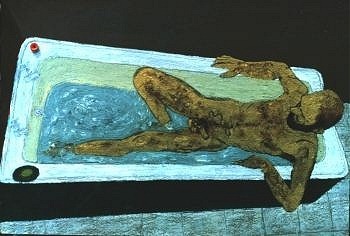
Self-portrait in the bath

of: The Transcendental Hotel:

"I keep this book among a small pile of books which claim my attention when I climb out from underneath my work."
- Tom Stoppard

"…what an incredible rage of witty /wise/weird sense/sound/cultural-reference-&-imaginative bombast Anthony Weir covers…"
- Cathal Dallat


Irish Landscape by Anthony Weir


of: Womb of Half-fogged Mirrors

"It is an extraordinary document, the repetitions not least. This book will help anyone caring for a relative with dementia."
- Alan Bennett

"A kind of diary of a woman in the initial stages of dementia, in the form of notes to her dead sister and her unacknowledged son (who adds a brief commentary). Her preoccupations with good coffee, wine and warmth are engaging; I found it compulsive reading."
- Sue Benson,
Journal of Dementia Care.

"This book invites the reader to experience, rather than merely observe, what is happening in all its incompleteness – incomplete because of course the memory itself is incomplete. I think it will be of genuine use to people."
- Michael Holroyd


of: This Website:

"I'm very jealous of your index page.
VERY very professional.
I'm a professional webmaster so I'm jealous as all get out."
- Fritters
http://www.relaxorium.com


Selfportrait-metamorphoto by Anthony Weir


THIS SORRY SCHEME OF THINGS


THE POETRY OF ANTHONY WEIR


by

Frederik Wolff


Portrait of Anthony Weir in 2003 by Artëm Kotenko

Anthony Weir’s poems are different from any others written in English. There may be echoes of Yeats, Blake, Lawrence, Wallace Stevens, perhaps even (faintly) of Donne and Swinburne, but he - a dedicated and lifelong Outsider, eschewing publishers, literary magazines all other Irish poets, and society in general - seems to be writing outside the tradition. There have been no dissident poets in Ireland until now.

Regarding himself as 'an atheist Untouchable, somewhere between Emily Dickinson, Nietzsche and William Blake' - and one of the last people in Ireland to heat his water for cooking and washing on a kettle over a fire - he claims that English poetry is dead. Not that it was ever exactly vibrant [he says], what with the clever less-than-profundities of Shakespeare, the arid sophistication of the pre-Romantics, and the risible posturings of the Romantics represented by a revered poem to a nightingale which in its second line denies that it is a bird. English poetry finally gave up the ghost in Eliot's Four Quartets, and the phenomenal success of 'Famous Séamus' Heaney is the numbingly-acceptable rattling of the same polished bones.

Perhaps the language – and tradition - that Weir should be writing in is Arabic or Persian. For his trenchancy recalls not only the great Omar Khayyám, who (along with Rilke and Yeats and the great Haiku-writers) is one of the greatest thinking poets of all time, but a great and noble Arabic tradition of dissent that few Westerners know about. Weir, as Entropic Poet is strikingly similar to the 10th century blind Syrian poet Abu al-‘Ala al-Ma‘arri – an intellectual, pessimist ascetic in the tradition of Diogenes of Sinope, who despised most other poets because he considered them frivolous or fawning. This is the kind of correspondance which Vedic texts call Bandhu: a conjugation, a binding of concurring thought across the ages.

At the same time, Anthony Weir links up with the East European poets of the Cold War period. He refers, in Post-Millennium Maggot *, to his favourite modern poet, Vasko Popa, a Serb whose poetry is adult where modern English poetry is neotenous, self-regarding, frivolous, fawning, anecdotal and trivial. He is also impressed by post-war Finnish and Macedonian poetry, and quotes from the great exiled Romanian poet, Ion Caraion.

Although he has translated poetry from the Old Irish, his work has nothing to do with the self-indulgence of modern Irish writing, which he despises as "all crafty form and little content like the civilisation (98% smash-and-grab and 2% art) we are trapped in". He does not feel Irish, or even European, but Outsiderish, "ashamed to be human" – thus a 'transcendental-nihilist poet of entropy', a lone voice against the self-justification of the life-denying cultures that have overrun the world.

[*published in THE HELLS GOING ON, Dissident Editions 1999.]


___________


TWO POEMS

translated from the Arabic of
Abu al-'Alá' Al-Ma'arri
(Blind Baghdadi, 973-1057)

by Anthony Weir


BILL OF SALE

God help us! we've all sold our integrity
to a business in the hands of the Receiver.
We don't count as creditors to be paid
and will inevitably be cheated.
Yet, given a choice between this swindling enterprise
and a state of authenticity
we'd always back corruption over honesty.


THE COMET

The comet: has it nerves in its long tail
- or is it dead ? Is it sentient
or just a flaming rock ?

Some believe in life beyond the grave
while others say we're only bits of meat.

I'd say: let's not be ugly beings,
let's do what's beautiful -
for I know that Consciousness
near death repents its wizened skin
which started out so fresh - and may do so again.


Selfportrait-metamorphoto by Anthony Weir


SEND IN
your own comments
or Review:

Leave a message in the
GUESTBOOK


weBlog
top of page